

Introduction
A catfish account is a fake profile that pretends to be you. Someone can use your photos, your stage name and your bio to collect followers, ask your fans for money or damage the trust you have built. Creators who post publicly can be targeted, because their photos and names are easy to find.
This guide explains how to recognise a fake account, how to report it yourself through each platform's own route, and what our catfishing and impersonation removal service adds when you want the reporting done for you.
What Is a Catfish Account?
A catfish account is a fake profile created to impersonate someone else. It typically uses your photos or videos, claims to be you, copies your stage name or branding, and may collect followers or money under false pretences.
Fake profiles can appear on social platforms, subscription platforms, dating sites, messaging apps and other online communities. Instagram, TikTok and X each have a dedicated report route for accounts that pretend to be someone.
Why Fake Accounts Cause Harm
- Money: some impersonators ask fans to pay for "exclusive content" or custom requests. That money goes to someone else, and fans who paid may blame you.
- Trust: fans can no longer tell which account is real, and your audience splits across accounts.
- Reputation: whatever the fake account says or does is linked to your name.
- Safety: your followers may be harassed or scammed, and a fake account may share personal details about you.
What Creators Commonly Report
Creators who deal with impersonation commonly report the same patterns:
- Fake accounts are created and re-created under new names after one is removed.
- Some impersonators copy the bio and posting style, then ask followers for money, for personal information, or start romantic conversations.
- Look-alike usernames send fans to a payment link that is not yours.
How to Recognise a Fake Account
Watch for these signs:
- Account details: an account created recently, a username close to yours but slightly different, a bio that claims to be you, a follower count or engagement that looks bought.
- Content: your photos posted without your permission, copied captions, no original content of its own.
- Behaviour: asking followers for money or personal information, selling content or services you do not offer, sending people to outside links.
- Messages from fans: followers asking which account is real, or telling you they were asked for money.
To look for fake accounts yourself, search your stage name, your usernames and close variations on each platform you use, set a Google Alert for your stage name, and ask your followers to tell you about accounts they do not recognise.
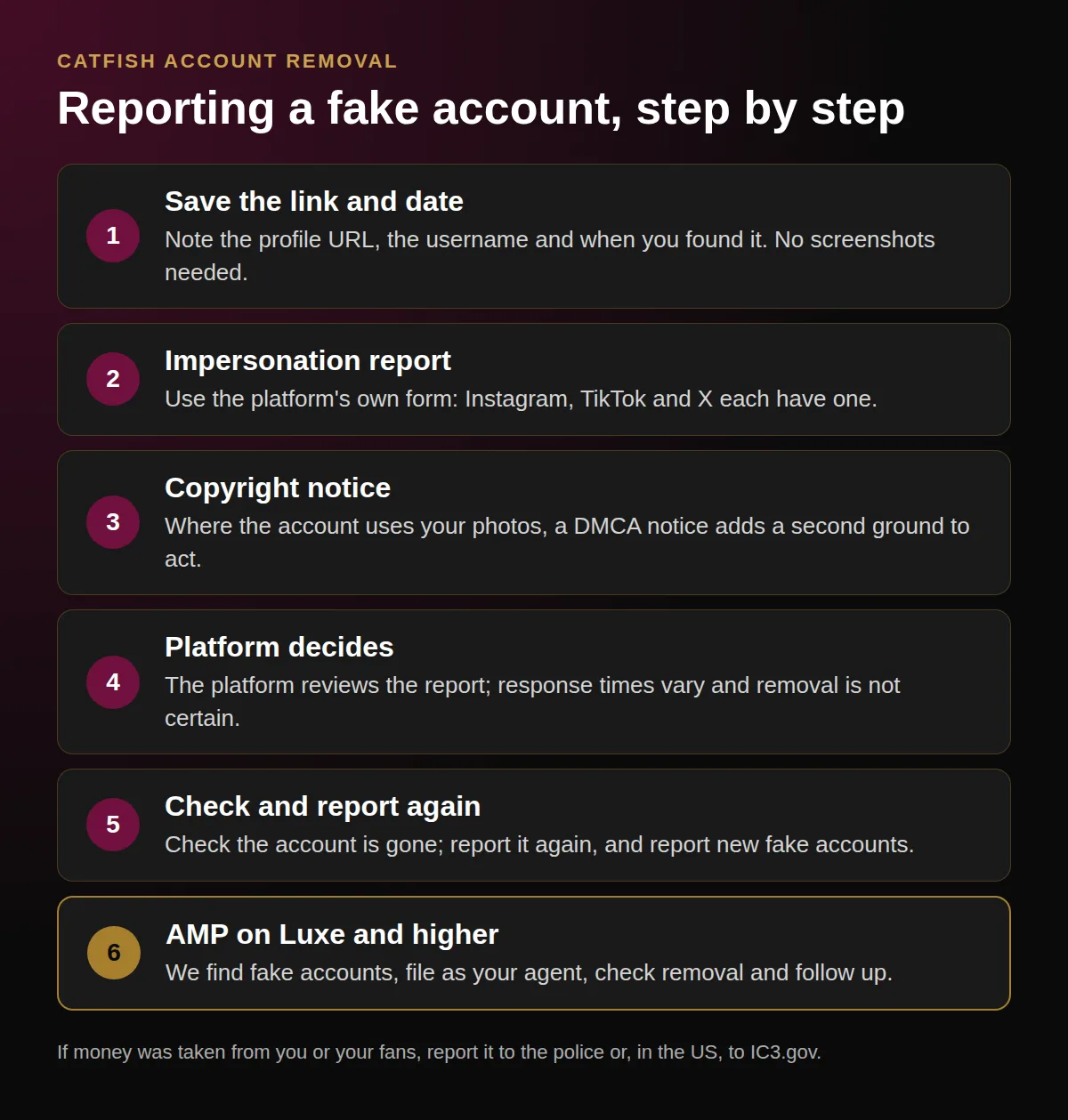
How to report a fake account, from saving the link to reporting new ones.
Reporting a Fake Account Yourself
You can report a fake account yourself, for free:
- Save the link and the date. Write down the profile URL, the username and when you found it. If the account posted sexual content, do not screenshot or download it; the link is enough for a report.
- Use the platform's impersonation route. Instagram and Threads have a dedicated impersonation form, TikTok has a report page for impersonation accounts (its form for US accounts asks you to upload a valid ID; the form for accounts outside the US does not mention ID), and X has its impersonation report. Instagram and X accept reports from the person who is impersonated or an authorized representative. Include a link to your real account.
- Add a copyright notice where your photos are used. Photos and videos you made are protected by copyright from the moment they are fixed in a tangible form (US Copyright Office). A DMCA notice for the copied media gives the platform a second ground to act. See how a DMCA notice works.
- Check and report again. The platform reviews the report and decides whether the account breaks its rules; response times vary. If the account is still there, report it again, and report new accounts as they appear. Meanwhile, tell your followers which accounts are yours and warn them not to pay the fake one.
- Report fraud. If money was taken from you or your fans, report it to the police or, in the US, to IC3.gov, the FBI's hub for reporting cyber-enabled fraud and scams. A lawyer of your choice can advise on legal steps. Adult Model Protection is not a law firm and does not give legal advice.
What Adult Model Protection Adds
The forms above are free to use. What AMP adds is the work around them:
- Finding fake accounts. On paid plans, our team runs regular scans and reverse image searches with the content assets you upload, and our takedown team also searches the social platforms by hand. You can submit links to fake accounts you know about from your dashboard, and you get a notification when we find something new. Your content assets are used only to search for copies and are never shared with third parties.
- Filing as your representative. We use each platform's own impersonation form and, where your photos are used, file a DMCA notice, under the name Adult Model Protection as your authorized representative. A person on our takedown team checks every report and notice before it is sent. Your legal name is only shared with your consent; the rights holder named on a DMCA notice is your model (stage) name, and the platform may show it to the uploader. Where a form needs your own ID and signature, such as TikTok's US impersonation form, you file it yourself with the URLs we collect; we do not submit ID documents.
- Checking and following up. After a report is sent, we check whether the account is gone and follow up with the platform when it is not. New fake accounts found in later scans or manual searches get a new report. Your dashboard shows each request and its status.
- Copies on other sites. On smaller sites that ignore a report, we escalate to the hosting provider, registrar, internet service provider, Cloudflare or payment processor, and to the abuse teams of Telegram or Discord.
Impersonation removal is included on the Luxe and higher plans, together with social media and messenger removals on Instagram, TikTok, X, Reddit, Snapchat, Telegram and Discord. Our estimate is 24 to 72 hours after filing; this is an estimate, not a guarantee, and the platform decides each report. AMP reports fake accounts and asks platforms to remove them; we do not identify who runs them.
Making Fake Accounts Easier to Spot
- Claim your stage name as a username on the platforms you use, even ones you rarely post on.
- Apply for verification wherever a platform offers it; TikTok, for example, suggests claiming your identity and applying for verification.
- Keep one links page with your official accounts and point fans to it.
- Pin a "my official accounts" post on your profiles, and tell your fans when you find a fake account.
- Keep your original files, which helps show that the content is yours.
- A lawyer can tell you whether trademarking your stage name makes sense for you.
If a fake account shares your real name, address or other personal details, see private information removal. For a wider look at fake profiles, read how to protect yourself from fake profiles and identity theft.
Frequently Asked Questions
Q: How long does it take to remove a catfish account? A: The platform decides each report. Our estimate is 24 to 72 hours after filing; this is an estimate, not a guarantee, and some cases take longer.
Q: Which platforms do you cover? A: We file impersonation reports on Instagram, TikTok and X, and social media and messenger removals on Reddit, Snapchat, Telegram and Discord as well, on the Luxe and higher plans. TikTok's form for US accounts asks for the impersonated person's own ID, so you file that one yourself with the URLs we collect; we do not submit ID documents.
Q: Will you tell me when a fake account is found? A: Yes. You get a notification when we find something new, and your dashboard shows each request and its status.
Q: What if the impersonator creates a new account after removal? A: New fake accounts found in later scans or manual searches get a new report, and you can submit any you spot first from your dashboard.
Q: Can you find out who is behind a fake account? A: No. We report fake accounts and ask platforms to remove them; we do not identify who runs them. If money was taken, the police or IC3.gov can investigate.
Want help reporting fake accounts? Start Free Plan or compare plans; impersonation removal is included on the Luxe and higher plans.