

Example scenario: a creator posts a new set and, a few weeks later, finds copies on several sites she has never heard of. By the time she has listed the links and found where to send each notice, more copies have appeared. Creators commonly report this pattern: copies spread to several sites, and finding and reporting them by hand takes time.
Anti-piracy services sell software and services to take over part of that work. Some describe their product as fully automated. This guide explains which parts of content protection software can help with, which parts still need a person, and what to ask before you choose a service. It also says plainly how Adult Model Protection (AMP) works today, including what is still in development.
Adult Model Protection is not a law firm and does not give legal advice. Where this guide mentions the law, it links the official source.
The Work Behind Every Takedown
Whether you do it yourself or pay a service, removing a copy of your content takes the same steps:
- Find the copy. Search engines, the sites where leaks commonly appear, social media and messengers.
- Check it is yours. Confirm the match is your content and that you own it (or are authorized to act for the owner).
- Send a complete notice to the right place: the site's own form or DMCA contact, or its host.
- Check whether it is gone, and follow up when it is not.
- Escalate when a site ignores the notice: its hosting provider, domain registrar, ISP, Cloudflare or a payment processor.
- Watch for re-uploads, which need a new notice.
The sooner a copy is found and reported, the sooner it can come down and the fewer people can see it. Software can speed up some of these steps. It cannot take over all of them.
What Software Does Well
Searching at scale. Tools can run the same searches over and over: your stage name and usernames in Google, Bing and Yandex, and reverse image searches with your own images. That is repetitive work that a person would otherwise do by hand.
Keeping the list. A dashboard can hold every link found, every notice sent, its status and the reply. That replaces a spreadsheet or notes, and makes it easier to see which sites act and which ignore notices.
Matching techniques. Some services use video fingerprinting or perceptual hashing, which compare the content of a file rather than its name, so they can catch copies that were cropped or re-encoded. At AMP these are in development and not current features. Our current detection is reverse image search with the content assets you upload, plus manual searches.
Integrations. Importing new content straight from a creator platform saves uploading it yourself. At AMP, API imports from OnlyFans and Fansly are in development and not available yet. Our roadmap lists what is being built.
What Still Needs a Person
Deciding that a match is really yours. A takedown notice must include a statement that you have a good faith belief the use is not authorized, and a statement that the information in the notice is accurate and, under penalty of perjury, that you are authorized to act for the owner (17 U.S.C. 512(c)(3)(A)). Someone who knowingly misrepresents that material is infringing can be liable for damages (17 U.S.C. 512(f)). A match from a tool is a lead, not proof.
Choosing the route. Each platform has its own form or contact, some sites list none, and a page in search results needs a separate request to the search engine. For a site without a contact, the US Copyright Office directory of designated agents is one place to look; not every site is listed.
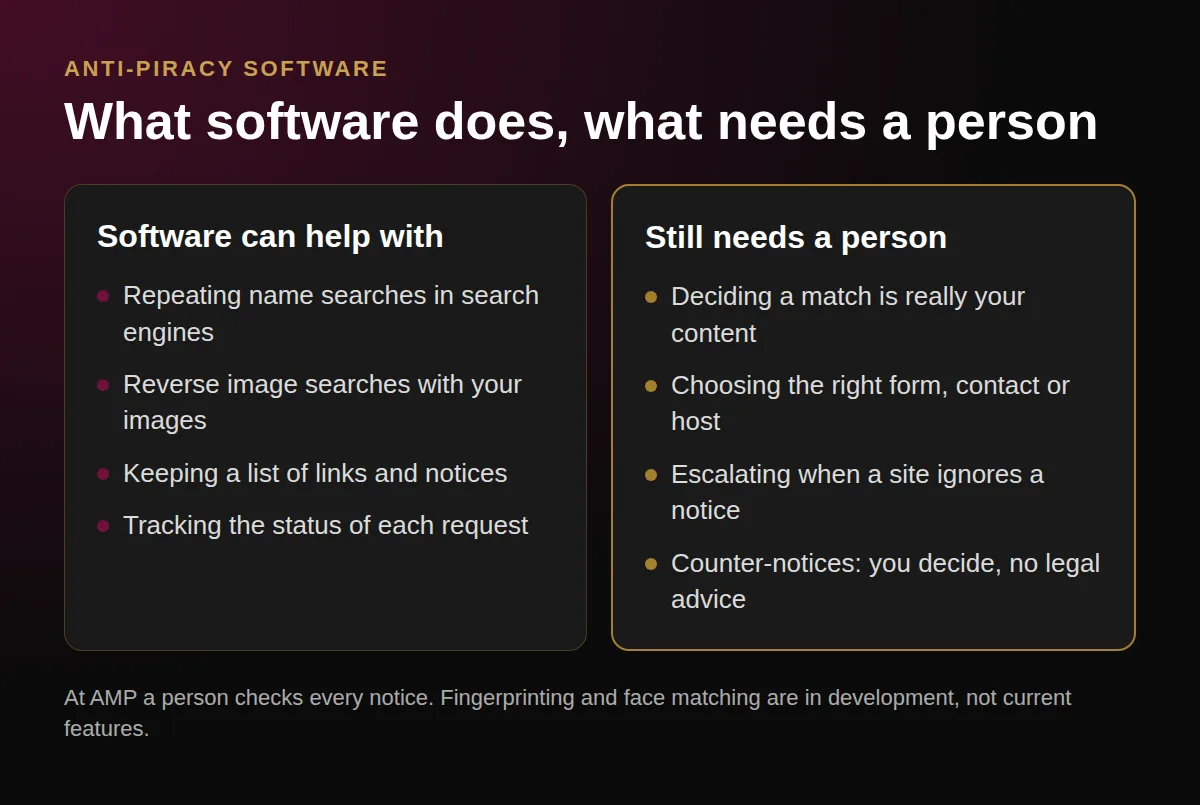
Which parts of a takedown software can take over, and which need a person.
Handling replies. A site is not legally required to remove content, but it loses the DMCA safe harbor protection if it does not act on a valid notice (17 U.S.C. 512(c)(1)(C)). When one does not act, someone has to decide where to escalate. If the uploader files a counter-notice, the platform may restore the content after 10 to 14 business days unless it is told within that period that the copyright owner has filed a court action (US Copyright Office). For a US work, registration (or a refused application) is generally required before such a court action (17 U.S.C. 411(a)). Our page on how a DMCA notice works covers notices and counter-notices in more detail.
Private groups and harder places. Private Telegram groups, private Discord servers and the dark web are not reachable by an ordinary search; finding copies there is manual work, and access is never guaranteed.
For a closer comparison, see our guide on automated vs hand-checked DMCA takedowns.
Questions to Ask Any Anti-Piracy Service
Before you pay for a service, ask:
- Who checks each notice before it is sent? A person, or nobody?
- Whose name is on the notice? Does the service file as your agent, and which name appears as the rights holder? Platforms such as Google share notices with the Lumen database, which may publish them.
- What do they search, and how? Which search engines and sites, and is the detection method a current feature or a plan?
- What happens after the notice? Do they check removal, follow up, escalate, and look for re-uploads?
- What does each plan include? Notice limits per month, which platforms are covered, and what happens when you reach a limit.
- Do they promise outcomes? No service can guarantee removal, because each site decides on each notice.
- Do they contact the person who posted your content? A service should never negotiate with or pay an uploader.
How Adult Model Protection Works Today
Finding copies. On paid plans, our team runs regular scans of Google, Bing, Yandex and more than 500 known leak and piracy sites, reverse image searches with the content assets you upload, and manual searches. Private Telegram groups and Discord servers are covered by our team where we can reach them, never guaranteed. The Free plan includes a quarterly web scan. Your content assets are used only to search for copies and are never shared with third parties. You get a notification when a scan finds a new copy.
Filing notices. Notices are filed under Adult Model Protection's name as your authorized agent, and a person on our takedown team checks every notice before it is sent. The rights holder named on the notice is your model (stage) name, and some platforms show it to the uploader; Google shares notices with Lumen, which may publish it. Your legal name is shared only with your consent and never with platforms that publish notices.
After the notice. We check whether each page is gone, through page checks and manual checks, follow up when it is not, and escalate to hosting providers, registrars, ISPs, Cloudflare or payment processors. Telegram and Discord cases can go to their abuse teams. Re-uploads found in later scans get a new notice. If a counter-notice arrives, our takedown team tells you and explains your options; the decision is yours.
Other reports. On the Luxe and higher plans we file impersonation reports for fake profiles that use your content, and requests to remove exposed private information, as your authorized representative. On the Glamour and higher plans our team also searches for deepfakes of you and requests their removal, and monitors the dark web. See impersonation removal and deepfake removal.
Your dashboard. It shows your scan results with a confidence score for each, your takedown requests by status (being prepared, removed, partly removed, closed), and a list of takedowns you can filter and export as CSV on paid plans. Analytics show your protected assets, the sites with detections and how many requests were removed, not removed or still in progress per period, with a downloadable PDF report. You can also submit links you found yourself as a new takedown request.
Plans. The Free plan includes a quarterly web scan, a dashboard preview and do-it-yourself guides, with no takedowns. Essentials includes unlimited search engine de-indexing, up to 100 platform notices a month and escalation. The Luxe and higher plans include unlimited notices, impersonation and private information removal, and takedowns on Instagram, TikTok, X, Reddit, Snapchat, Telegram and Discord. The Glamour and higher plans add deepfake detection and removal, dark web monitoring and 24/7 emergency response. See the plans for the details.
Our estimate for a complete notice to a site that responds to notices is 24 to 72 hours; it is an estimate, not a guarantee, and some sites take longer or do not respond.
Doing It Yourself
You can do all of this without a service, for free. Platforms publish their own copyright forms, and Google takes copyright removal requests through its Legal Help Center; it reports an average processing time of about 6 hours for requests through its web form. You do not need a lawyer to send a takedown notice (US Copyright Office).
What you take on is the time: searching regularly, listing exact URLs, writing a complete notice for each site, checking afterwards and starting again for re-uploads. Our guide on how DMCA takedowns work walks through it step by step. Our search engine de-indexing service covers the search results part.
FAQ
Is AMP's scanning automated?
No. On paid plans, our team runs regular scans with scanning tools and also searches by hand. Scans are not continuous or real-time; you get a notification when a scan finds a new copy.
Does a service get better takedown results than doing it myself?
No one can promise that. A complete notice to the right place and a follow-up when there is no response give a request its best chance, whoever sends it. What a service saves you is the time spent searching and filing.
Is a service worth it with a small content library?
That depends on how many copies you find and how much time you want to spend. The Free plan's quarterly web scan shows what we can find before you decide.
Conclusion
Software helps with the repetitive parts of content protection: searching, keeping a list and tracking each request. The judgement calls, such as whether a match is yours, where to send a notice and what to do when a site ignores it, still need a person. Choose a service that tells you plainly which is which.
Want help with this? Start Free Plan for a quarterly web scan and a dashboard preview, then compare the plans to see which one includes the takedowns you need.