

What Content Protection Means for Creators
For creators who sell exclusive content on platforms such as OnlyFans and Fansly, content protection means three things: making copies harder to spread, finding the copies that are made, and getting them removed. No single step covers all three, and none of them makes copying impossible.
Creators commonly report that their content is copied and reposted on tube sites and in groups. A leaked copy can compete with your paid page, and creators commonly report feeling violated when their content is shared without their consent. This guide is about what you can do yourself: prevention habits, searching for copies, filing notices and the legal basics behind them.

Prevention: Making Copies Harder to Spread
No platform setting stops a subscriber from recording a screen. Creators commonly report that copies are made with screen recording or download tools. Prevention still helps, because it makes copying more work and makes your copies easier to recognise.
Use the platform's own tools. OnlyFans' copyright help page lists a watermark option, Digital Rights Management (DRM) protections that creators can enable in the "Privacy and Safety" section of their settings, DMCA takedowns and a form to report stolen content (OnlyFans Transparency Center). DRM makes some kinds of copying harder; it does not stop someone from filming a screen.
Add a visible watermark. A watermark with your creator name or handle makes it clear where a copy came from. It can be cropped or blurred out, so it is a deterrent, not a lock. Our guide to watermarking strategies goes into detail.
Marked versions for different audiences. Some creators release slightly different versions of a set to different tiers, so that a copy shows which tier it came from. This is a general idea some creators try; it does not prove who made a copy. Adult Model Protection does not identify who leaked your content, and per-subscriber watermarking is a feature we have in development.
Secure your own workflow. Some creators keep separate devices, email addresses and accounts for content work, use strong unique passwords and two-factor authentication, and keep secure backups of their original files. Keeping your originals with their dates also helps if a host ever asks about a notice.
Finding Copies of Your Content
The sooner a copy is found, the fewer places it has usually reached. Searching by hand takes time, but there are tools that help.
Reverse image search. Tools such as TinEye compare an image with images they have indexed and find copies that were cropped, resized, colour adjusted or slightly rotated; TinEye notes that it cannot recognise what is in an image (TinEye FAQ). Google and Bing also offer image search by picture.
Search your names. Search your creator name, handles and common misspellings in Google and Bing, including image results.
Having it done for you. On paid plans, Adult Model Protection's team runs regular scans of Google, Bing, Yandex and 500+ known leak and piracy sites; see how a DMCA takedown service works. Our guide to detecting content leaks early covers the search side in more detail.
DMCA Takedown Notices
The Digital Millennium Copyright Act (DMCA) sets up the US notice-and-takedown process. A takedown notice asks the host to remove the material. A host that responds expeditiously to remove or disable access to it after a compliant notice keeps its US safe harbour from liability (17 U.S.C. 512). A site is not legally required to remove content, but it loses the DMCA safe harbor protection if it does not act on a valid notice (US Copyright Office).
A notice identifies your work and the copy, gives your contact details and a good-faith statement that the use is not authorized, and carries a statement that the information in the notice is accurate and, under penalty of perjury, that you are authorized to act for the owner, plus a signature (17 U.S.C. 512(c)(3)). You do not have to upload proof of ownership with it. See how a DMCA notice works for the full list, and our guide to understanding DMCA takedowns.
The person who uploaded the copy can file a counter-notice. Under US law, the platform may restore the content after 10 to 14 business days unless it is told within that period that the copyright owner has filed a court action (US Copyright Office).
Platforms differ in their forms and in what they show the uploader. Many forward the notice to the person who uploaded the content, and notices sent to Google may be published by Lumen. For OnlyFans content in particular, see our page on removing leaked OnlyFans content.
Search Engine De-indexing
A copy that a host leaves online can still be removed from search results. Google and Bing accept copyright removal requests for search results; removing a result does not remove the page itself. Our page on search engine de-indexing explains how this works.
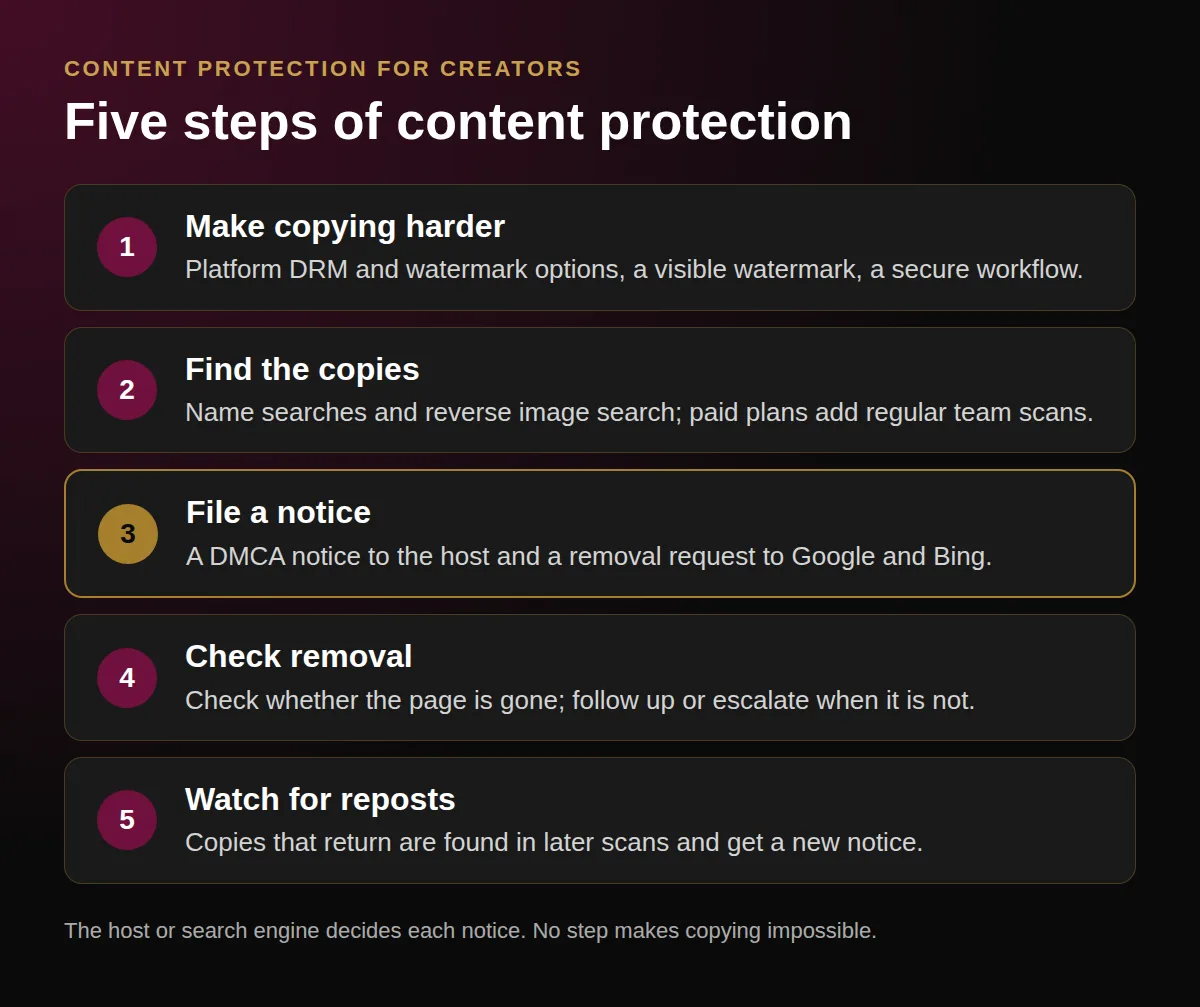
Prevention, searching, notices and follow-up work together.

Filing Yourself or With a Service
You can file notices yourself, for free, through each platform's own copyright form or Google's form. That works well for a few copies. It takes time when copies are spread over many sites, and every notice you file yourself goes out under your own details.
If you would rather hand the finding, filing and follow-up to someone else, our DMCA takedown service files notices as your agent; platform notices start on the Essentials plan (up to 100 a month), with unlimited notices on the Luxe and higher plans.
Legal Basics
Adult Model Protection is not a law firm and does not give legal advice. These are general descriptions with links to the official sources; a lawyer can tell you what applies to you.
Your rights. Copyright gives the owner exclusive rights to reproduce the work, prepare derivative works, distribute copies to the public and display the work publicly (17 U.S.C. 106). In the US, a work is under copyright protection the moment it is created and fixed in a tangible form, and registration is voluntary (US Copyright Office).
Registration. Registration is not needed to send a takedown notice. It matters if you sue in the US: statutory damages and attorney's fees are generally not available for infringement that started before registration, unless the work was registered within three months of first publication (17 U.S.C. 412).
Letters and lawsuits. A lawyer can advise whether a letter or a lawsuit makes sense in your case. For a US work, registration (or a refused application) is generally required before you can sue for infringement (17 U.S.C. 411(a)).
Intimate images shared without consent. This is a separate route from copyright. In the US, the TAKE IT DOWN Act (Public Law 119-12) requires covered platforms, since 19 May 2026, to remove a reported intimate image of an identifiable individual, published without consent, within 48 hours of a valid request, and to make reasonable efforts to identify and remove known identical copies (FTC). If someone threatens to share an image that is not published yet and you are 18 or over, StopNCII creates a hash on your own device, so you never send the image itself; for images taken before you turned 18, use Take It Down. See our guide to the TAKE IT DOWN Act.
Hosts outside the US. A notice can be sent to a host in another country, but whether it acts on a US-style notice is up to that host.
Keeping Records
Keep a simple log: the link to each copy, the date you found it, the notice or request you filed, and the result. Save the link and the date; do not download copies or take screenshots of pages with sexual content. That log is enough to file again if a copy returns.
Conclusion
Content protection is ongoing work: prevention makes copying harder, regular searches find the copies that are made, and notices, removal checks and follow-ups get them taken down where the host or search engine agrees. You can do much of it yourself with the platforms' own tools.
Want help finding and removing copies? The Free Plan includes a quarterly web scan and a dashboard preview. Platform takedown notices start on the Essentials plan, with up to 100 a month, and the Luxe and higher plans include unlimited notices. Start Free Plan or compare plans.