
What This Guide Covers
This guide looks at how content theft commonly shows up for adult creators, what the law offers in 2026, and what you can do about it. It is based on patterns creators commonly report and on official sources, not on measured data about how much content is stolen.
How Content Theft Commonly Shows Up
Creators commonly report the same patterns:
- Paid content copied to free sites. Content from subscription pages gets copied to free sites and private groups.
- Copies on several sites. A leaked video can appear on more than one site quickly, and copies come back after a removal.
- Recorded live shows. Live shows get recorded and reposted. Our page on cam model protection covers that case.
- Reposts and impersonators on social media. Content is reposted by accounts that are not yours, sometimes by accounts that pretend to be you.
- Fake images. AI tools can be used to edit images or to make fake images of real people.
Each of these needs a different removal route, which is why it helps to know which case you are dealing with.
AI on Both Sides
AI tools can be used to make sexual images of real people who never made them. Those fakes have their own removal routes: platform reports for intimate images shared without consent and, for covered platforms, the TAKE IT DOWN Act (see below). Our page on deepfake removal explains the routes; deepfake removal is included on the Glamour and higher plans.
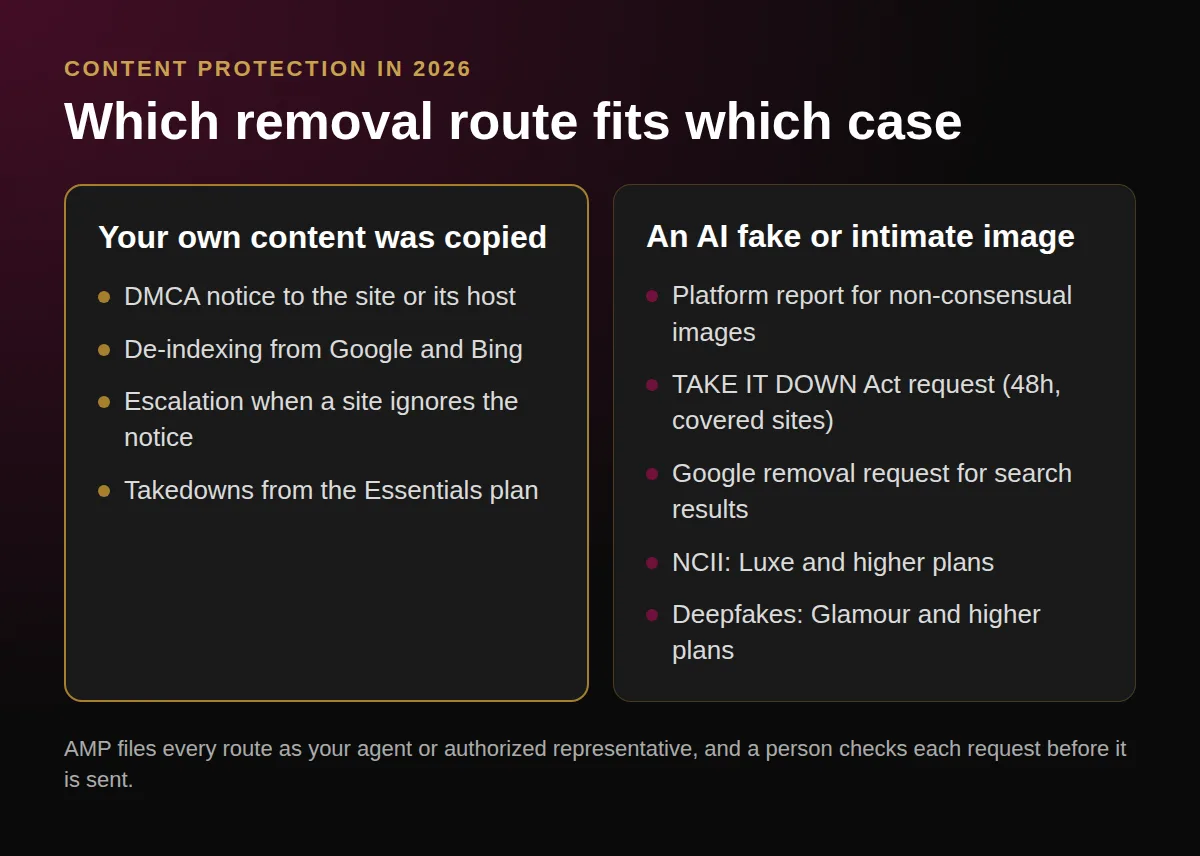
Copyright notices cover your own content; fakes and intimate images have their own routes.
Adult Model Protection (AMP) finds copies with regular scans by our team on paid plans, reverse image searches with the content assets you upload, and manual searches. Content fingerprinting and face matching are in development and not yet available.
The Legal Tools in 2026
DMCA notices. A DMCA notice is the usual first step against a copy on a site or host that follows US copyright rules. Under 17 U.S.C. 512, a service provider keeps its safe harbor protection only if it responds expeditiously to a valid notice (US Copyright Office). Some sites hosted abroad ignore notices; the next steps are then the site's host and registrar, and de-indexing requests to the search engines. Our guide on how DMCA takedowns work walks through the process.
Copyright registration. In the US, copyright exists automatically once an original work is fixed, and you do not need to register to send a takedown notice. Registration can matter if you later go to court: under 17 U.S.C. 412, statutory damages and attorney's fees generally depend on timely registration. For a US work, registration (or a refused application) is also generally required before you can sue for infringement (17 U.S.C. 411(a)). A copyright lawyer can tell you what applies to your works.
The TAKE IT DOWN Act. The TAKE IT DOWN Act (Public Law 119-12, signed on 19 May 2025) makes it a federal crime to knowingly publish intimate images of an identifiable individual (adult or minor) without consent, including AI-generated "digital forgeries", when the conditions in the Act are met. Since 19 May 2026, covered platforms must remove a reported image within 48 hours of a valid request and make reasonable efforts to identify and remove known identical copies. The Act lets an authorized person file the request on your behalf; our guide to the TAKE IT DOWN Act explains it in more detail. The DEFIANCE Act, which would add a federal right to sue over sexual deepfakes, has passed the Senate only and is not law.
Adult Model Protection is not a law firm and does not give legal advice.

What You Can Do Yourself
- Check for copies. Google reverse image search with images you have already published, searches for your stage name, and Google Alerts are free. Our guide on detecting content leaks explains each check.
- Save the link and the date. When you find a copy, keep the URL and the date. Do not download the copy or take screenshots of the page.
- File the platform's own form. Mainstream platforms such as X and Reddit have a copyright form you can use for free.
- Use a visible watermark. A watermark with your stage name or page address makes copies easier to find with a text search. AMP's own watermarking is in development and not yet available.
- Review your approach from time to time. Our docs page on building a protection strategy has a checklist.
What a Protection Service Adds
Doing all of this by hand takes time, and copies keep coming back. AMP's takedown team takes on the work:
- Regular scans on paid plans of Google, Bing and Yandex and of more than 500 known leak and piracy sites, plus reverse image searches and manual searches
- A DMCA notice for each copy within your plan (Essentials: up to 100 platform notices a month; Luxe and higher: unlimited), filed under the name Adult Model Protection as your authorized agent; a person checks every notice before it is sent
- De-indexing requests to Google and Bing, and escalation to the host, registrar, ISP, Cloudflare or payment processor when a site ignores a notice
- Removal checks after each notice, and new notices for copies found again in later scans
- Impersonation reports, intimate-image (NCII) reports and TAKE IT DOWN Act requests on the Luxe and higher plans; catfishing and impersonation removal explains that route
- Dark web monitoring and deepfake removal on the Glamour and higher plans
Our estimate for removal is 24–72 hours after filing; this is an estimate, not a guarantee, and some sites take longer or do not act. AMP never identifies who leaked or made content. Our page on DMCA takedowns for adult content explains the whole process.
Start With a Free Scan
The Free plan includes a quarterly web scan, so you can see what is already out there. Takedowns start on the Essentials plan.