
What Copyright Means for Digital Creators
In the United States, copyright protects your original content from the moment you create it. The US Copyright Office says: "Your work is under copyright protection the moment it is created and fixed in a tangible form" (US Copyright Office). That covers the photos, videos and other recorded work you make.
This guide explains what you own, how long it lasts, what fair use is, why registration matters, how protection works abroad, and how creators enforce their rights. It is based on US law and the official sources linked in each section. Adult Model Protection is not a law firm and does not give legal advice; for advice on your own situation, ask a lawyer.
What You Own
As the copyright owner you hold the exclusive rights listed in 17 U.S.C. 106, including the rights "to reproduce the copyrighted work in copies", "to prepare derivative works" and "to distribute copies ... to the public", as well as the rights to perform and display the work publicly. Each of these rights, "including any subdivision", may be transferred and owned separately (17 U.S.C. 201(d)(2)).
Registration is not needed for ownership. The Copyright Office says "In general, registration is voluntary", while "Registered works may be eligible for statutory damages and attorney's fees in successful litigation" (US Copyright Office).
What fans get. Fans who pay for your content do not get ownership of it. On OnlyFans, for example, the terms say you "authorise your Fans to access and view your Content on OnlyFans for their own lawful and personal use, and in accordance with any licenses that you grant to your Fans" (OnlyFans Terms of Service). Check the terms of each platform you use.
What copyright does not cover. Copyright protects the recorded work, not the idea behind it. Protection does not extend "to any idea, procedure, process, system, method of operation, concept, principle, or discovery" (17 U.S.C. 102(b)). Someone can make content on the same theme as yours; they cannot copy your actual photos and videos.
How Long Copyright Lasts
For most works by an individual author created on or after 1 January 1978, US copyright lasts for the author's life plus 70 years (17 U.S.C. 302(a)).
This matters if you publish under a stage name. For "an anonymous work, a pseudonymous work, or a work made for hire", the term is "95 years from the year of its first publication, or a term of 120 years from the year of its creation, whichever expires first" (17 U.S.C. 302(c)). The same section explains that the life-plus-70 term applies instead when the author's identity is revealed in the Copyright Office's records.
Fair Use
Fair use allows some use of a copyrighted work without permission. The statute lists purposes "such as criticism, comment, news reporting, teaching (including multiple copies for classroom use), scholarship, or research" (17 U.S.C. 107). Whether a use is fair depends on four factors (US Copyright Office Fair Use Index):
- The purpose and character of the use
- The nature of the copyrighted work
- The amount and substantiality of the portion used in relation to the work as a whole
- The effect of the use on the potential market for or value of the copyrighted work
The Copyright Office stresses that "there is no formula": courts weigh the factors case by case, and not every commercial use is unfair or every noncommercial use fair. Two factors are relevant to creators. The Office says that "a more creative or imaginative work ... is less likely to support a claim of a fair use", and the fourth factor asks whether the use harms "the existing or future market for the copyright owner's original work".
Posting a full copy of a creator's paid content on a free site is therefore unlikely to be fair use, because it copies the whole work and can replace the paid original. Whether a specific use is infringement is a question for a court, decided on its facts.

Registering Your Copyright
Why register
- You need it to sue for a US work. "No civil action for infringement of the copyright in any United States work shall be instituted until preregistration or registration of the copyright claim has been made" (17 U.S.C. 411(a)). If the Copyright Office refuses an application, the same section still lets you sue after a refusal, with notice to the Office. The Copyright Office puts it plainly: "You will have to register, however, if you wish to bring a lawsuit for infringement of a U.S. work" (US Copyright Office).
- Statutory damages and attorney's fees. These are generally available only if the work was registered before the infringement began or within three months of first publication (17 U.S.C. 412). Without them, you are generally limited to actual damages and the infringer's profits, which you must prove.
- Evidence. A registration certificate made "before or within five years after first publication ... shall constitute prima facie evidence of the validity of the copyright" (17 U.S.C. 410(c)), and registration puts the facts of your claim on the public record.
You do not need a registration to send a DMCA takedown notice. The Copyright Office says: "A copyright registration is not required before sending a takedown notice" (US Copyright Office, Section 512).
How to register
Registration takes effect when the Copyright Office receives "an application, deposit, and fee" (17 U.S.C. 410(d)). The deposit is a copy of the work or other identifying material. Creators with many works can look at the group options:
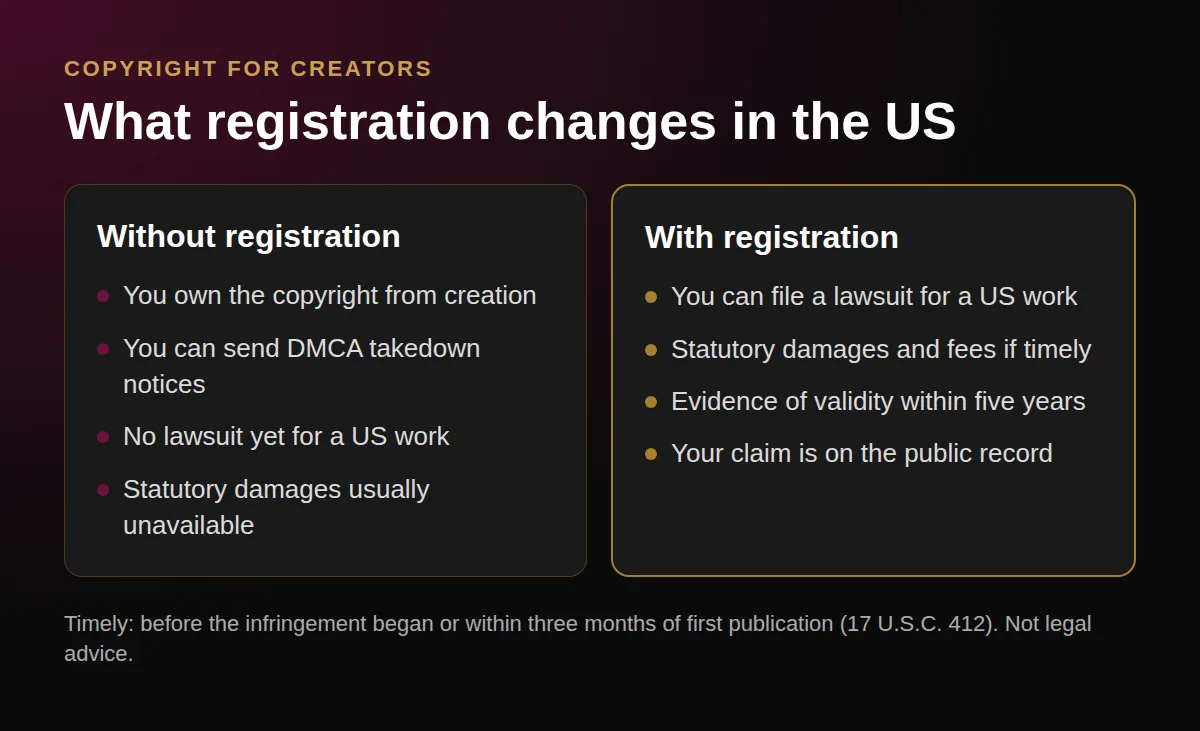
Registration is voluntary, but it decides which remedies are open to you.
- Group registration for published photographs: "A group of published photographs may be registered with the U.S. Copyright Office with one application and one filing fee" (US Copyright Office).
- Group registration of unpublished works: "You may register up to ten unpublished works" in one application (US Copyright Office).
Check the current requirements and fees on copyright.gov before you file.
Protection in Other Countries
The Berne Convention, the main international copyright treaty, has more than 180 member countries (WIPO), and works from one member country are protected in the others. Copyright terms, exceptions such as fair use or fair dealing, and enforcement routes differ between countries, so the US rules above do not apply everywhere.
Enforcing Your Copyright
Find the copies. Creators commonly report copies of their paid content on other sites and in search results. You can check yourself with searches for your stage name and reverse image searches; how to detect content leaks explains how. Some creators also watermark their content with their stage name or site, so copies are easier to recognise.
Send a DMCA notice. A DMCA takedown notice is the main legal route for asking a platform or host to remove infringing copies. A site is not legally required to remove content, but it loses the DMCA safe harbor protection if it does not act on a valid notice (US Copyright Office, Section 512), so results and response times vary. If the uploader sends a counter-notice, the platform may restore the content after 10 to 14 business days unless it is told within that period that the copyright owner has filed a court action. See how a DMCA notice works and how DMCA takedowns work.
Ask search engines to remove results. A copy that stays online can still be removed from Google and Bing results through their own copyright forms; see search engine de-indexing.
Keep records. Keep your original files, your publication dates, the links to each copy, the date you found it, and every notice and reply. Do not download or screenshot the copies themselves; the link and the date are enough.
Court action. A lawsuit is the owner's decision and needs a lawyer. Copyright law provides for actual damages and the infringer's profits, or statutory damages per work infringed, up to $150,000 per work for willful infringement (17 U.S.C. 504(c)). For a US work, registration (or a refused application) is generally required before you can sue (17 U.S.C. 411(a)).
What Adult Model Protection Does
You can send DMCA notices and use Google's and Bing's forms yourself, for free. What we add is the work around them:
- Finding copies. On paid plans, our team runs regular scans with search engines (Google, Bing and Yandex) and 500+ known leak and piracy sites, reverse image searches with the content assets you upload, and manual searches. Your content assets are used only to search for copies and are never shared with third parties.
- Filing as your agent. We file notices under the name Adult Model Protection as your authorized agent. The rights holder named on the notice is your model (stage) name. A person on our takedown team checks every notice before it is sent.
- Checking afterwards. We check whether each page is gone and follow up when it is not, and copies found in later scans get a new notice. If a counter-notice arrives, our takedown team tells you and explains your options; you decide.
Search-engine de-indexing and up to 100 platform notices a month are included from the Essentials plan; the Luxe and higher plans include unlimited notices and takedowns on social media platforms. Fingerprinting and watermarking are in development and not part of the service today. The platform or search engine always decides; we cannot guarantee a result.
For more background, see the copyright basics page in our docs.
Key Takeaways
- In the US, copyright starts when you create and fix the work; registration is voluntary.
- Works published under a pseudonym have a different term unless your identity is on record with the Copyright Office.
- Fair use depends on four factors, decided case by case.
- For a US work, registration (or a refused application) is generally required before suing; you do not need a registration to send a DMCA notice.
- Registering before infringement, or within three months of publication, keeps statutory damages and attorney's fees available.
Want to see where your content appears? The Free Plan includes a quarterly web scan, a dashboard preview and DIY guides; takedowns start on a paid plan. Start Free Plan or compare plans.