
Why Creators Look at Content Protection Services
Many adult creators earn income through platforms like OnlyFans and Fansly. Creators commonly report that their paid content is copied and reposted elsewhere, and leaked content can compete with your paid page.
You can find copies and file removal notices yourself, for free, through each platform's own copyright form and Google's form. A content protection service does that work for you: it searches for copies, files notices, checks whether they worked and follows up. This guide explains what such a service does, what no service can do, and what to ask before you choose one.
What a Content Protection Service Does
Finding copies. A service searches search engines and the sites where copies of adult content are often posted. Reverse image search is one of the tools: Google says its results include "similar images" and "websites with the image or a similar image" (Google Search Help), so it can surface some edited copies as well as exact ones.
Filing notices. In the US, the main route for removing a copy from a host is a DMCA takedown notice. A host that responds expeditiously to remove or disable access to the material after a compliant notice keeps its safe harbour from liability (17 U.S.C. 512). The host reviews the notice and decides; see how a DMCA notice works. A copy that stays online can also be removed from search results through Google's and Bing's copyright routes (search engine de-indexing).
Following up. Not every site answers the first notice. A service checks whether the page is gone, follows up, and can escalate to the companies the site depends on, such as its hosting provider.
Watching for reposts. Creators commonly report that removed content gets re-posted. Later searches find new copies, and each new copy needs a new notice.
What No Service Can Do
- Make copying impossible. Anyone who can view your content can record a screen.
- Guarantee removal. The host, platform or search engine decides each notice. A host outside the US may or may not act on a US-style notice.
- Stop a counter-notice. The person who uploaded a copy can file one. Under US law, the platform may restore the content after 10 to 14 business days unless it is told within that period that the copyright owner has filed a court action (US Copyright Office). For a US work, registration (or a refused application) is generally required before suing (17 U.S.C. 411(a)).
- Decide fair use for you. Fair use permits the unlicensed use of copyright-protected works in certain circumstances, and courts evaluate fair use claims case by case (US Copyright Office). Whether a use is fair use depends on the facts; ask a lawyer if you are unsure.
Be careful with any service that promises "100% removal", "real-time" detection or that it will find out who leaked your content.
Questions to Ask Before You Choose
How does it search? Ask which search engines and how many sites it covers, whether people search by hand as well as with tools, and what is automated and what is not. Ask what it does with the content you upload to search with.
Who files the notice, and under which name? Ask whether notices go out under your own name or the service's name as your agent, which name is shown as the rights holder, and who can see it. Many platforms forward notices to the uploader, and notices sent to Google may be published by Lumen.
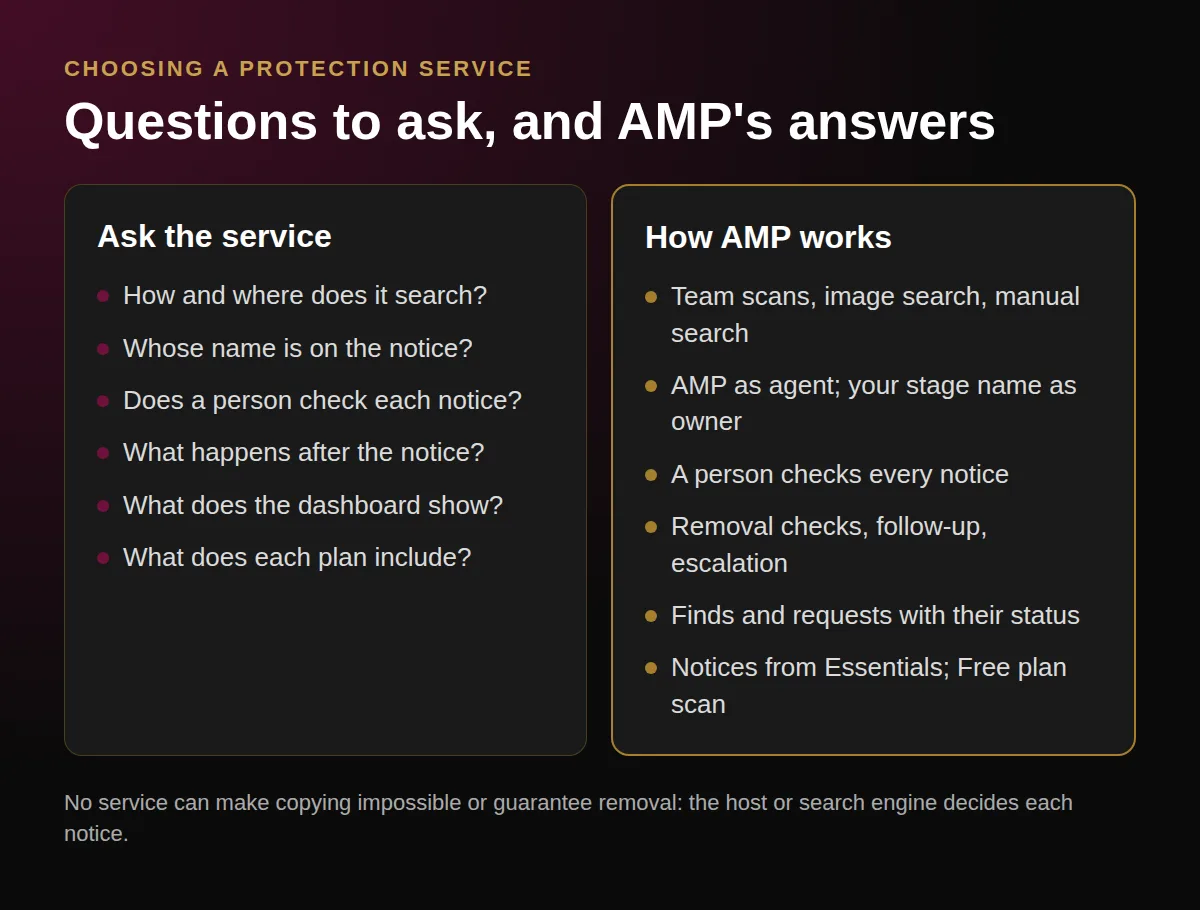
What to ask before you choose, with how AMP answers each question.
Does a person check each notice? A wrong notice can hit the wrong page or name the wrong work.
What happens after the notice? Ask whether the service checks that the page is gone, follows up when it is not, and what it does when a site does not respond.
What do you see? Ask what the dashboard shows: what was found, which requests were sent and their status.
What does it cost? Ask how many notices each plan includes, which platforms each plan covers, and whether you can cancel.
How Adult Model Protection Answers
The graphic above sums up our answers: on paid plans our team runs regular scans and files notices as your agent, a person checks every notice, and we check removal and follow up; the details are on our DMCA takedown service page and, for OnlyFans content, on removing leaked OnlyFans content. Platform notices start on the Essentials plan (up to 100 a month), the Luxe and higher plans include unlimited notices and social media removals, and the Glamour and higher plans add deepfake removal and dark web monitoring. Adult Model Protection is not a law firm and does not give legal advice.

Keeping Your Own Records
Whether you use a service or not, keep a short log: the link to each copy, the date you found it, the notice you filed and the result. Save the link and the date; do not download copies or take screenshots of pages with sexual content. Our guide to understanding DMCA takedowns and the post on content protection analytics go further.
Conclusion
A content protection service saves you the searching, filing and follow-up, but it cannot make copying impossible or guarantee that a site removes content. Choose one that tells you plainly how it searches, who files the notices and under which name, and what happens afterwards.
Want to see what is already out there? The Free Plan includes a quarterly web scan and a dashboard preview. Start Free Plan or compare plans.